

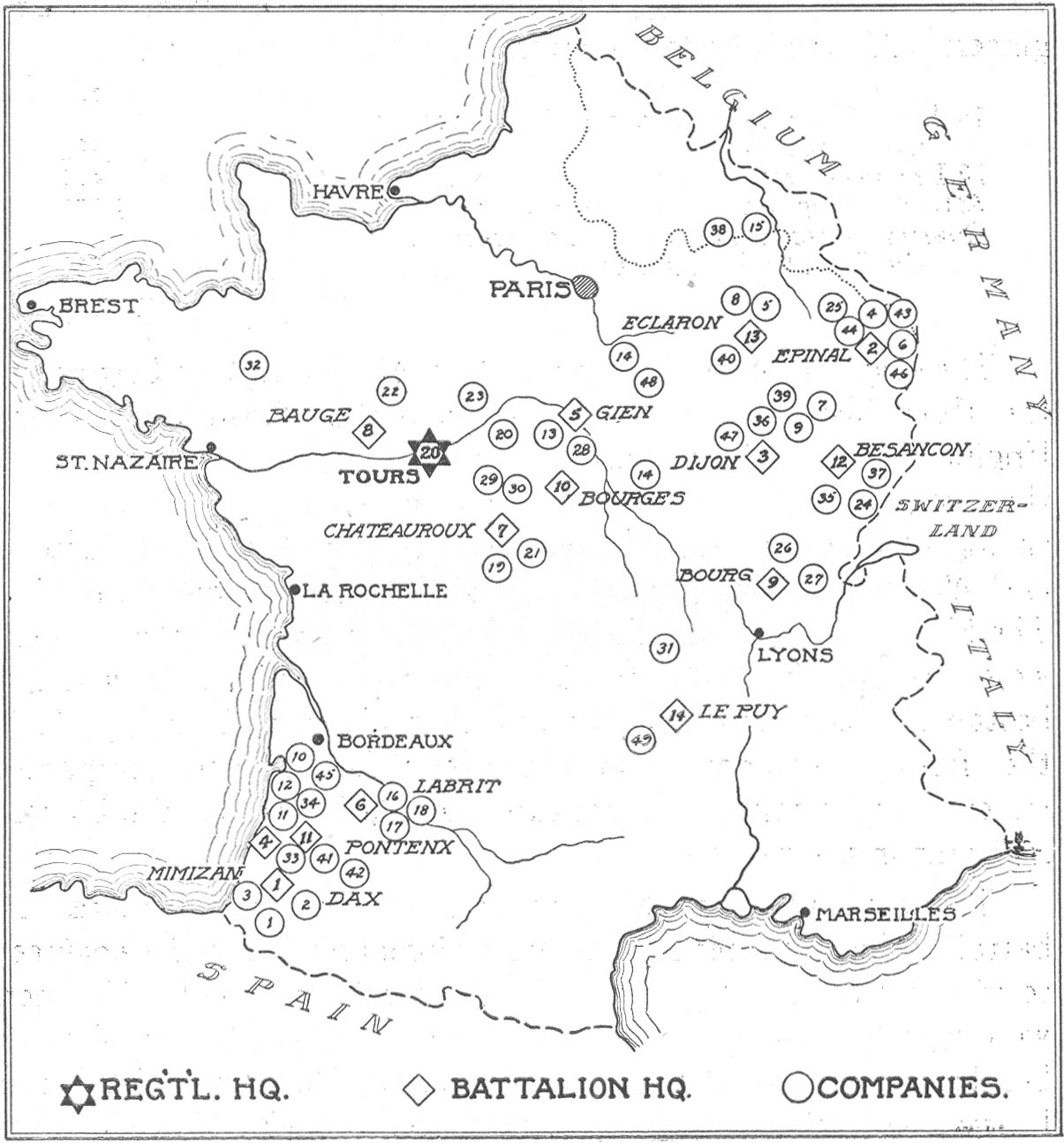
The 20th Engineer Regiment operated throughout France. Click on the map to the right to open a new window to see the locations of every company and battalion in the Regiment, as well as the Regimental headquarters in Tours.
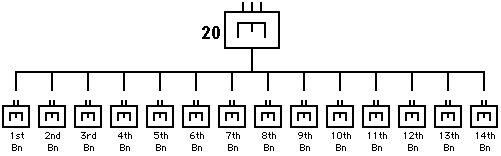
The 20th Engineers was the largest regiment ever to exist in the United States Army. From its beginning in 1917, it grew to over 500 officers and 46,025 soldiers by Armistice Day in 1918. The organization included 14 battalions deployed to France, with another 14 battalions and additional company-sized units attached, and 15 more battalions still organizing in the United States. Its missions were among the most diverse of the American Expeditionary Forces, from operating within direct combat range of German forces, to units scattered along the Spanish border; its soldiers were among the first to arrive in France, and among the last to return home. The primary function of the 20th Engineers was forestry--to produce lumber and timber for Allied forces--but its flexibility and command structure allowed for a wide range of other engineer missions.
A short time after the United States
declared war with Germany, plans for an adequate force of forest
engineers were drawn up. Urged by the Joffre Mission to America by the
British Mission by the cabled request of General Pershing, the War
Department made the rapid formation of forestry troops one of its
primary obligations to the American Expeditionary Forces.
The Allied lines of communication depended upon great amounts of timber and ties; docks, literage, storage facilities, shelter, hospitalization, ice-making plants, bakeries, and fuel. The front lines required lumber for dugouts, trench construction, entanglements, compounds for prisoners, bridges, and a great variety of other uses-even coffins.
The first step taken provided for the
organization of the 10th Engineers (Forestry). This regiment,
consisting of two battalions of three companies each, was authorized as
an emergency measure May 17, 1917, and formally authorized by General
Order No 78 on June 27th. The United States Forest Service assumed the
task of recruiting the regiment, and many Government foresters answered
the call to arms.
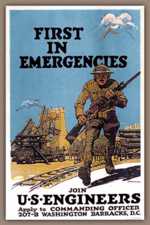 | The Agriculture
Department and its Forest Service helped the War Department recruit
professional and trained foresters for the various forestry units that
eventually coalesced into the 20th Engineer Regiment. Even the Chief
Forester (Henry S. Graves) and Assistant Chief Forester (William B.
Greeley) left the Forest Service to join the 20th Engineers. Click the poster to the left to see a variety of recruiting materials specific to the 20th Engineers, plus a recruiting letter from the Chief Forester. |
The 10th Engineers sailed from New York on the "Carpathia" on
September 10, 1917, under the command of Colonel James A. Woodruff.
The "Carpathia" landed at Glasgow, Scottland; from there the regiment
traveled to Southampton, the across the English Channel to Le Havre,
then Nevers, where the regiment was dispersed across France to conduct
operations. There were some of the first American troops to serve in
France.
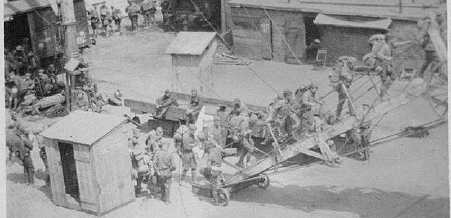
Soldiers
of the 42nd Engineers (later the 42nd, 43rd, and 44th Companies of the
20th Engineers) boarding the USS President Lincoln on May 10th,
1918. The ship landed at Brest, France on May 23rd. On its return
trip to the United States, the Lincoln was torpedoed and sank on
May 31st.
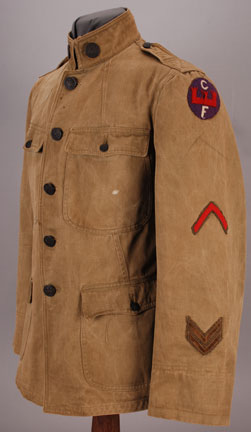
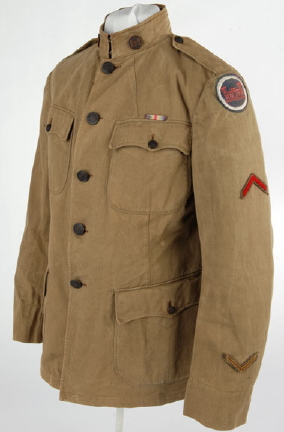
General Pershing quickly
realized the 10th would be insufficient for the size force he
envisioned for the AEF. In cable No. 27 on July 4th, 1917, and in
several additional cables afterwards, he requested four additional
regiments of lumbermen. This request was passed to the War College
Division for further study and as a result General Order No. 108 was
issued on August 15, 1917, authorizing one regimental headquarters, 10
battalions of forestry engineers of three companies each, and nine
engineer service battalions of four companies each.

"European War Mobilization - 20th Regiment Engineers (Forestry)
Camp American University, Washington, D.C. - Oct. 1917"
The 20th Engineer
Regiment was formed on September 9, 1917 at American University in
Washington, D.C. Major Earl S. Atkinson was in command until relieved
on September 15th by Colonel W. A. Mitchell, who had been stationed in
the office of the Chief of Engineers working on the regiment's
organization. Due to limited capacity at American University, the
battalions were organized over a stretch of time, with a few units
billeted at Fort Myer and Camp Belvoir, Virginia, for short periods of
time.
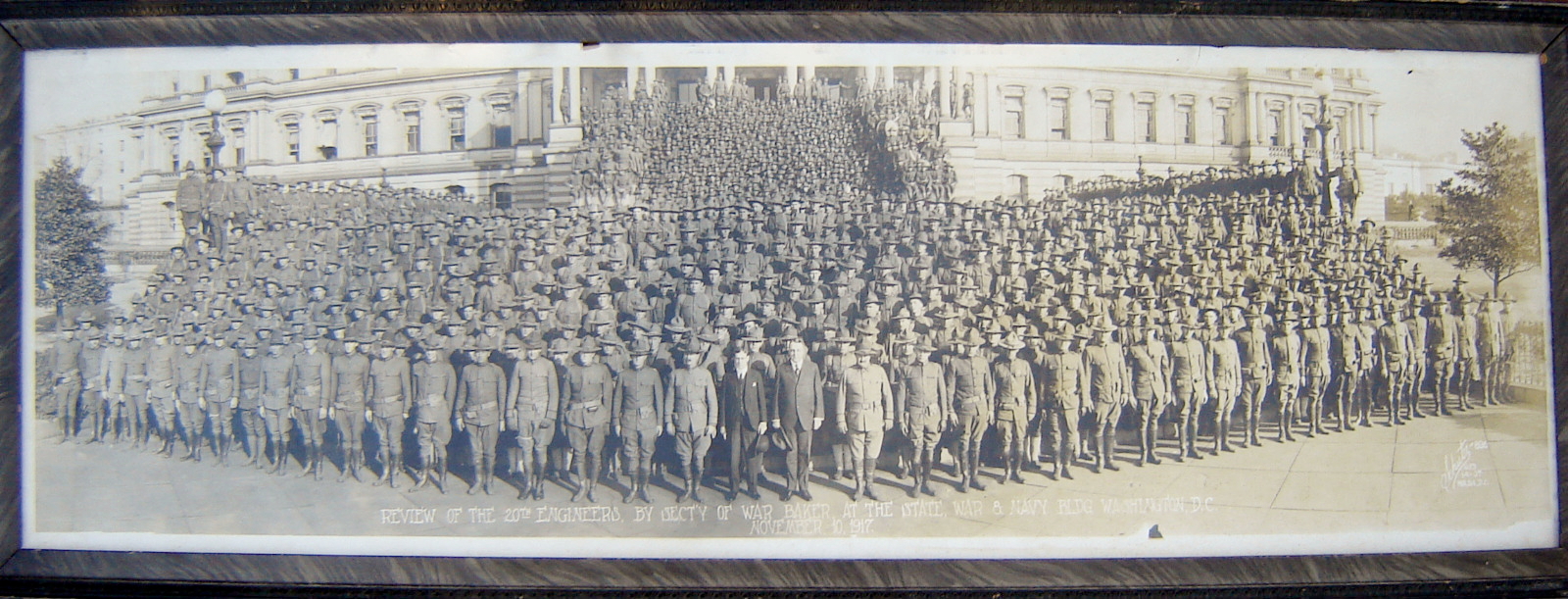
"Review of the 20th Engineers, by Sect'y of War Baker, at the State, War & Navy Bldg., Washington, D.C."
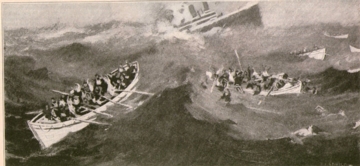 Units of the Regiment shipped out over a
period of time, with the 1st and 2nd Battalions of the 20th Engineers
departing for France on November 11, 1917. Part of the 6th Battalion
of the 20th Engineers was shipped to France aboard a former British
transport ship. With the engineers and others embarked,
the SS Tuscania was torpedoed by a German U-Boat off the coast of
the Isle of Islay, Ireland. Over 200 US soldiers died in the incident,
95 of them from the 6th Battalion, 20th Engineers. (Photo courtesy of
the Saturday Evening Post, March 1918.)
Units of the Regiment shipped out over a
period of time, with the 1st and 2nd Battalions of the 20th Engineers
departing for France on November 11, 1917. Part of the 6th Battalion
of the 20th Engineers was shipped to France aboard a former British
transport ship. With the engineers and others embarked,
the SS Tuscania was torpedoed by a German U-Boat off the coast of
the Isle of Islay, Ireland. Over 200 US soldiers died in the incident,
95 of them from the 6th Battalion, 20th Engineers. (Photo courtesy of
the Saturday Evening Post, March 1918.) 
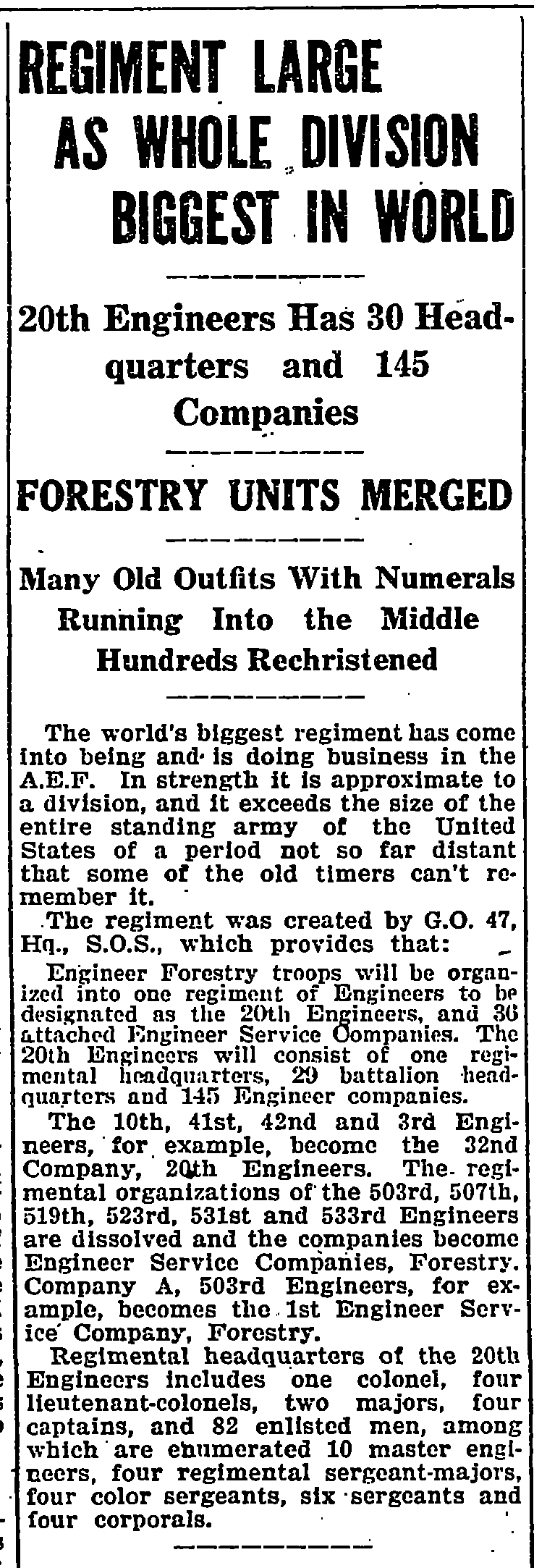
The 20th Engineer Regiment appeared in several editions of the AEF's overseas newspapers, the Stars and Stripes. Click the header above to see a number of the articles. Click the article header to the right to see the November 8, 1918, article about the merger of the forestry regiments.
On October 18, 1918, General Order No. 47 reorganized all U.S.
forestry units under the 20th Engineer Regiment, with a planned
endstate of 29 battalions. The two battalions of the 10th Engineer
Regiment became the 11th Battalion and 12th Battalion, 20th Engineer
Regiment. Three former Road and Bridge battalions were also folded
into the 20th Engineer Regiment: the 41st Engineer Battalion became
the 13th Battalion, 20th Engineer Regiment; the 43rd Engineer Battalion
became the 14th Battalion, 20th Engineer Regiment; and the 42nd
Engineer Battalion headquarters was disbanded and its companies
redesignated. All the lettered companies of the old battalions were
renumbered from 1st through 49th Engineer Company (Forestry).
See the Reorganization Table.
The remaining 15 battalions of the 20th Engineers--another 26,000 men--
were in various states of organization and training at the time of the
Armistice, and
were never deployed to Europe.
In addition to the organic battalions of the
20th Engineers, there were
auxiliary units assigned to the 20th Engineer Regiment, to include
seven Engineer Forestry Service Battalions: the 503rd, 507th, 517th,
519th, 523rd, 531st, and 533rd Engineers. These battalions'
headquarters were eventually disbanded and the companies redesignated
as the 1st through 28th Engineer Forestry Service Companies, and
assigned as an organic part of the 20th Engineer Regiment. In
addition to the Engineer Forestry Service Battalions, there were other
auxiliary units attached to
the Regiment. There were 14 battalion-sized units: two Engineer
Service Battalions (the 547th and 548th Engineers), and twelve
Quartermaster Battalions (the 309th, 314th, 320th, 323rd, 324th, 328th,
329th, 331st, 332nd, 333rd, 335th, and 342nd Labor Battalions). There
were also an assortment of separate company-sized units, including Pack
Trains, Wagon Companies, and a Motor Truck Company. All in all,
not counting the units that were never shipped to Europe, the 20th
Engineers had more than 500 officers and 46,000 soldiers assigned or
attached by the time of the Armistice. It was the only organization in
the A.E.F. that had a soldier from every State in the Union. The first operations were in the pinewood nurseries
of the Landes, in the valley of the Loire, and in the softwood forests
of the Vosges and Jura Mountains. Many of the operations were started
temporarily with small mills obtained in France, which were overhauled
to increase production above their rated capacities. Practically all
the mills were kept going day and night.
Standard gauge
railroads up to three miles in length were built at two-third of the
operations for connecting the mill docks with French rail lines. Much
of the logging was done with horses and mules; motor trucks and
tractors were used increasingly as they became available. Monthly
needs of the AEF rose to 50,000,000 board feet of lumber and timber;
250,000 railroad ties; 6,500 pieces of piling and ribbing; 1,500,000
poles and entanglement stakes; and 100,000 cords of fuelwood. Limited
quantities of these were obtained from the U.S., France, Switzerland,
Norway, and Spain; but the vast majority was produced by U.S. forestry
troops.
Detachments of trained woodsmen were needed with the infantry
divisions at the front. These often engaged in direct combat with the
Germans. Losses included two
officers of the 20th Engineers who were killed by German machine
gunners. With the Armistice came a temporary slow-down in
operations. Two battalions (the original 10th Engineers) were shipped
home quickly, but the rest of the 20th Engineers were delayed to helped
reconstruct France. One of these final feats included operations in
the famous
Burned Area. Various parts of
the regiment were shipped home during the first parts of 1919, with the
last units arriving in Hoboken, New Jersey, in July.
Soldiers killed in the war were at first buried in temporary gravesites. Many of the
remains were returned to families in the United States after the war. Some families
chose to have their loved ones remain in cemeteries in Europe.
See the full list of
soldiers of the 20th Engineers who are buried in overseas military cemeteries.
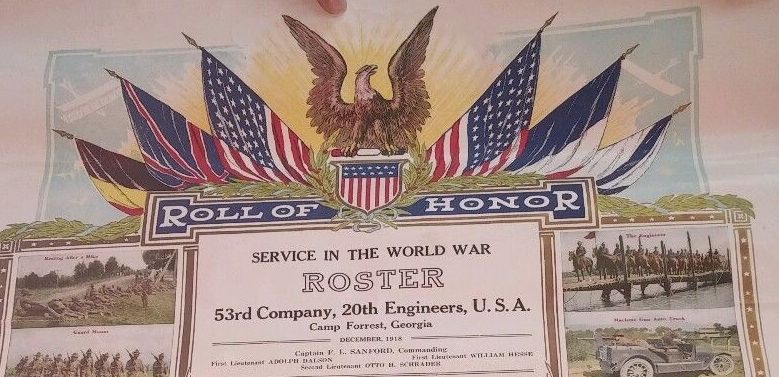
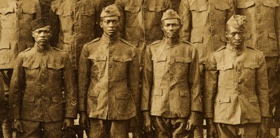
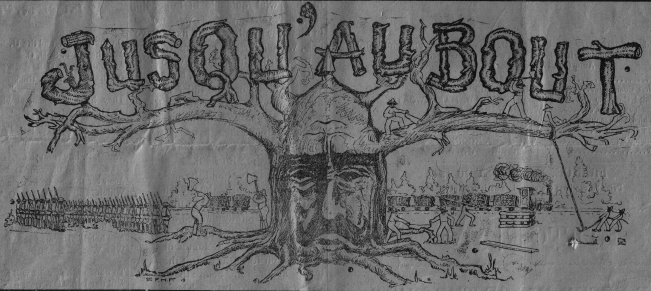
Companies A and C of 1st Battalion, 20th Engineers published
a newspaper "somewhere in France" named Jusqu'au Bout ("To The
End," or more probably, "Until It's Over"). Note the banner shows a
tree whose trunk resembles Kaiser Wilhelm, with foresters working to
take it down. Also shown are stacks of lumber and ties, a train
pulling timbers, and files of marching doughboys. Click on the photo
to see more images of the paper.
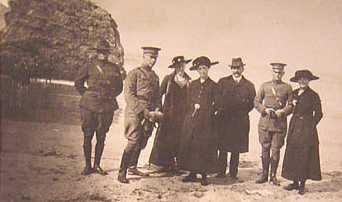
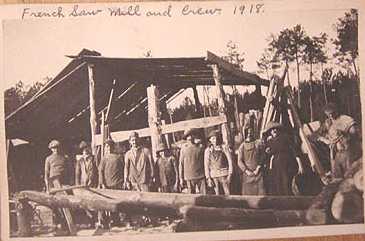
Photos from 1st Company (Company A, 1st Battalion),
20th Engineers
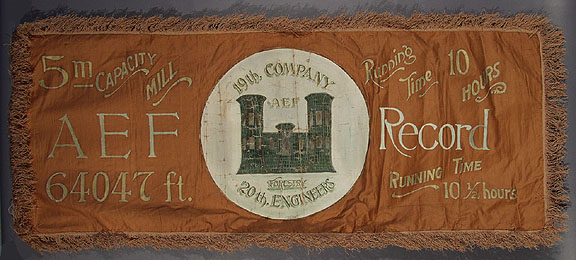

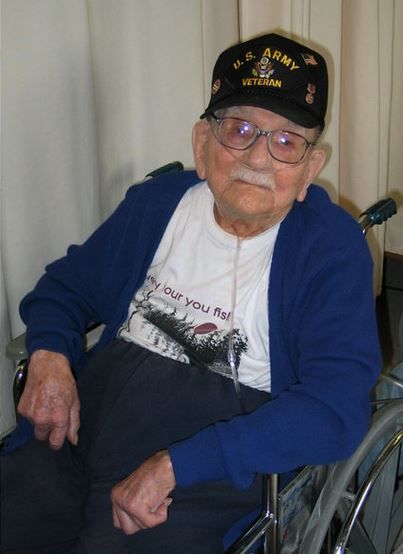
Private Arthur Anton Fiala
Company B, 9th Battalion, 20th Engineers
The last surviving soldier from the 20th Engineers of WW1
1899 - 2005
French Forests for Our Army
A quick look at Forestry operations after the war
Several months after the end of the war,
American Forestry, the magazine of the American Forestry
Association, dedicated a special commemorative issue in June of 1919 to
the work done by the 20th Engineers during World War I. Included in the
retrospective were articles written by some of the commanding officers
of the forest engineer units, as well as a large number of photographs
documenting the work and experiences of the forestry troops.
Click on the photo to
see a variety of articles and photos from the magazine.
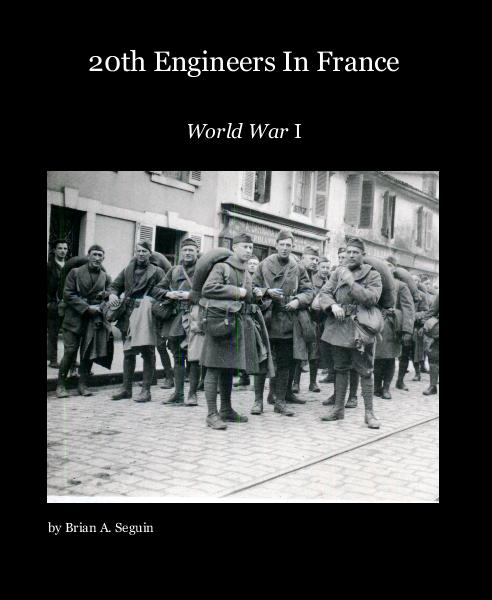
See personal information on a few of the individuals
that served in the 20th Engineers during the Great War.