

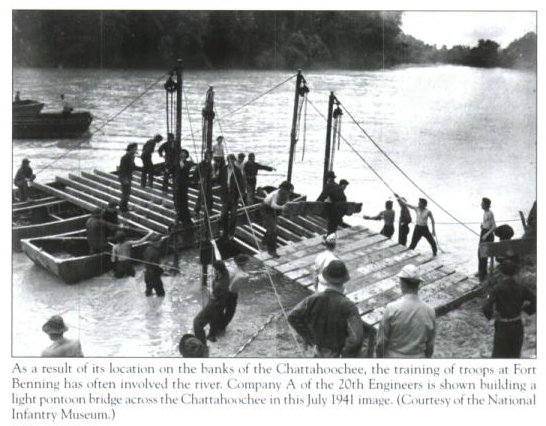
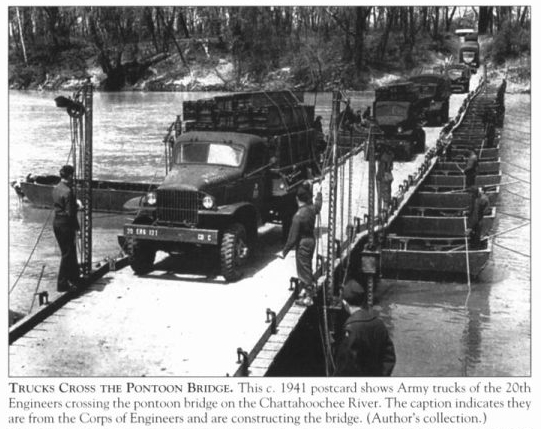
 On 1 July 1940, the 20th Engineer Combat Regiment was organized and activated at Fort Benning, Georgia, under the command of Colonel Bill Heavey. For the previous thirty days, beginning on 1 June 1940, the 42nd Engineer Regiment (General Service) had been forming at Fort Benning; all assets of the 42nd were redesignated as part of the new 20th Engineer Combat Regiment.
During 1941, the 20th Engineer Regiment grew to its full strength of a regimental headquarters and two combat engineer battalions of 4 combat engineer companies each, with a total of 1450 men. The regiment's pre-war training exercises included a major part in the Louisiana Maneuvers. Immediately after the attack on Pearl Harbor, Colonel Heavey was ordered to Burma to join General "Vinegar Joe" Stilwell, and the 20th's executive officer, Eugene Caffey (USMA June 1918), took over command.

Click on the picture for information |

|
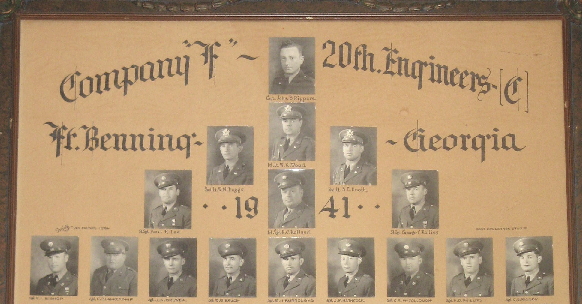
Photos of the officers and men of Company F, 2nd Battalion, 20th Engineers
Subsequently, the regiment helped in the construction of Camp Shelby, Mississippi and Camp Beauregard, Louisiana. The 20th Engineer Regiment was transferred to Camp Blanding, Florida, on 15 January 1942; Camp Kilmer, New Jersey, on 26 July 1942; and Camp Picket, Virginia, on 21 September 1942.
 Fort Benning. |
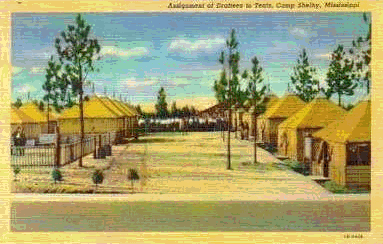 Camp Shelby |
 Camp Beauregard. |
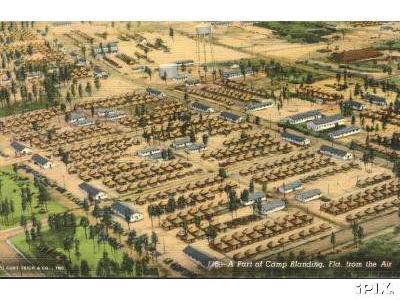 Camp Blanding |
 Camp Kilmer (1950s). |
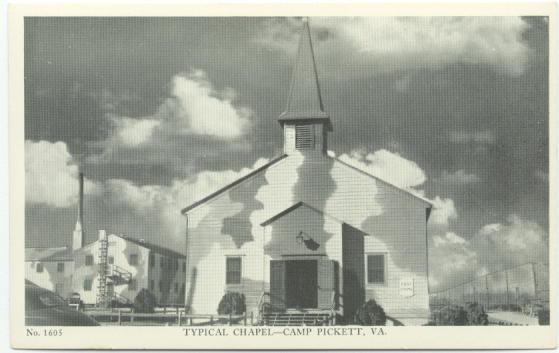 Camp Pickett |
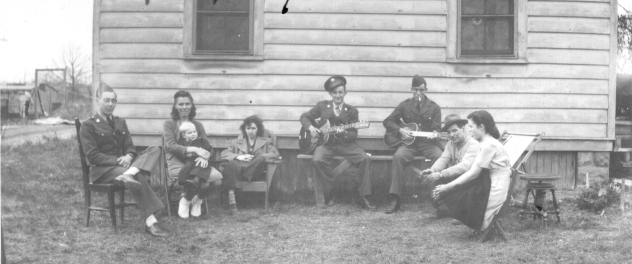
Click the photo to learn about one of the favorite R&R spots for the soldiers of the 20th Engineers while stationed at Camp Kilmer. "Maw and Paw" Brown of North Stelton, New Jersey, opened their modest home so soldiers could relax, eat home cooking, and spend time with local families.
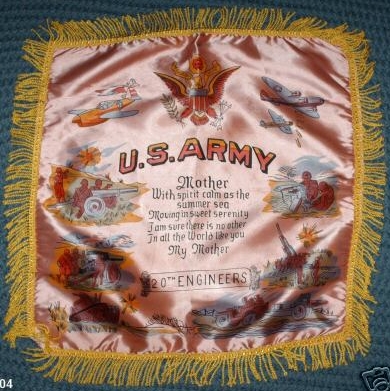

On 22 October the 2nd Battalion left Camp Pickett for the port of embarkation at Newport News, Virginia, where they boarded the USAT Hugh L. Scott and set sail for parts unknown.
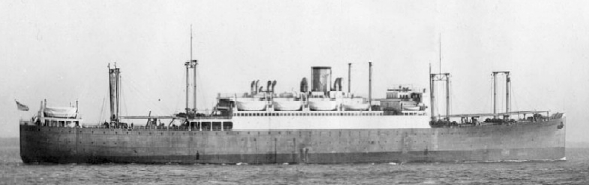
US Army Transport Hugh L Scott
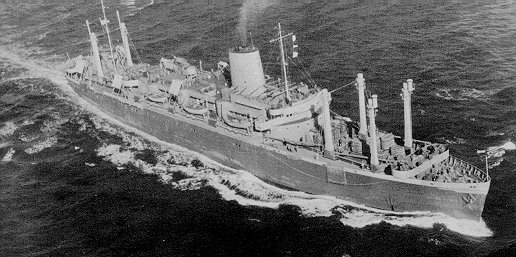
US Army Transport Cristobal
At the time of departure no one knew that the regiment was bound for assignment in the Western Task Force of Operation Torch. The soldiers were not told of their destination -- Casablanca, French North Africa -- until after the ship was at sea a couple of days.
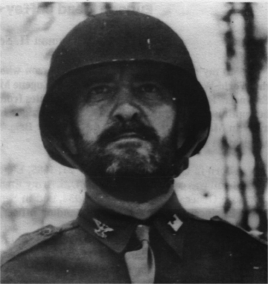
This photograph of Colonel Eugene M. Caffey was taken in October 1942 at Camp Pickett, Virginia. Initially, Caffey ordered that anyone who did not shave for two days then had to obtain his permission to shave. This helped establish the 20th Engineer Combat Regiment as different from every other outfit, and it also boosted morale. Later, Colonel Caffey ordered everyone to shave off their beards because it interfered with the wearing of gas masks. Click the picture of Colonel Caffey to read comments on him from his family.
The 2d Battalion, 20th Engineer Regiment, was attached to the 3rd Infantry Division while at sea. It commenced landing in Fedala the afternoon of November 8 and by the next day had completed taking over police and local security missions in the town. Throughout the operation they continued to perform these functions. They relieved the 1st Battalion, 7th Infantry, which was enabled to go into regimental reserve.
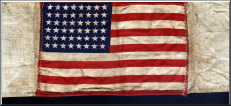
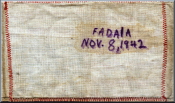
Armband worn by Elmer Lee Sturgill, Company D, 2nd Battalion, 20th Engineers, during the assault and occupation of Fedala, Morocco. Photos courtesy Kenneth L Sturgill, his son.
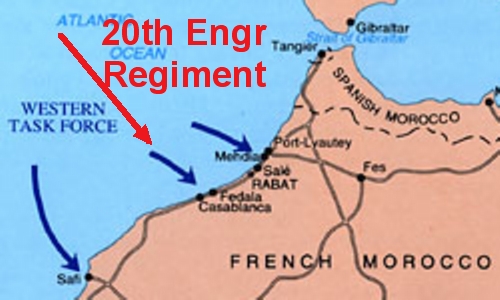
The rest of the regiment landed on 19 November,
and as reported by one engineer, "we emerged from the bowels of the good ship,
loaded down with full field packs, gas masks and arms and carrying on our
backs the largest and heaviest barracks bags that ever made an invasion." Once
on the dock, in formation and with the band playing, the regiment marched through the
streets of Casablanca amid an astonished citizenry.
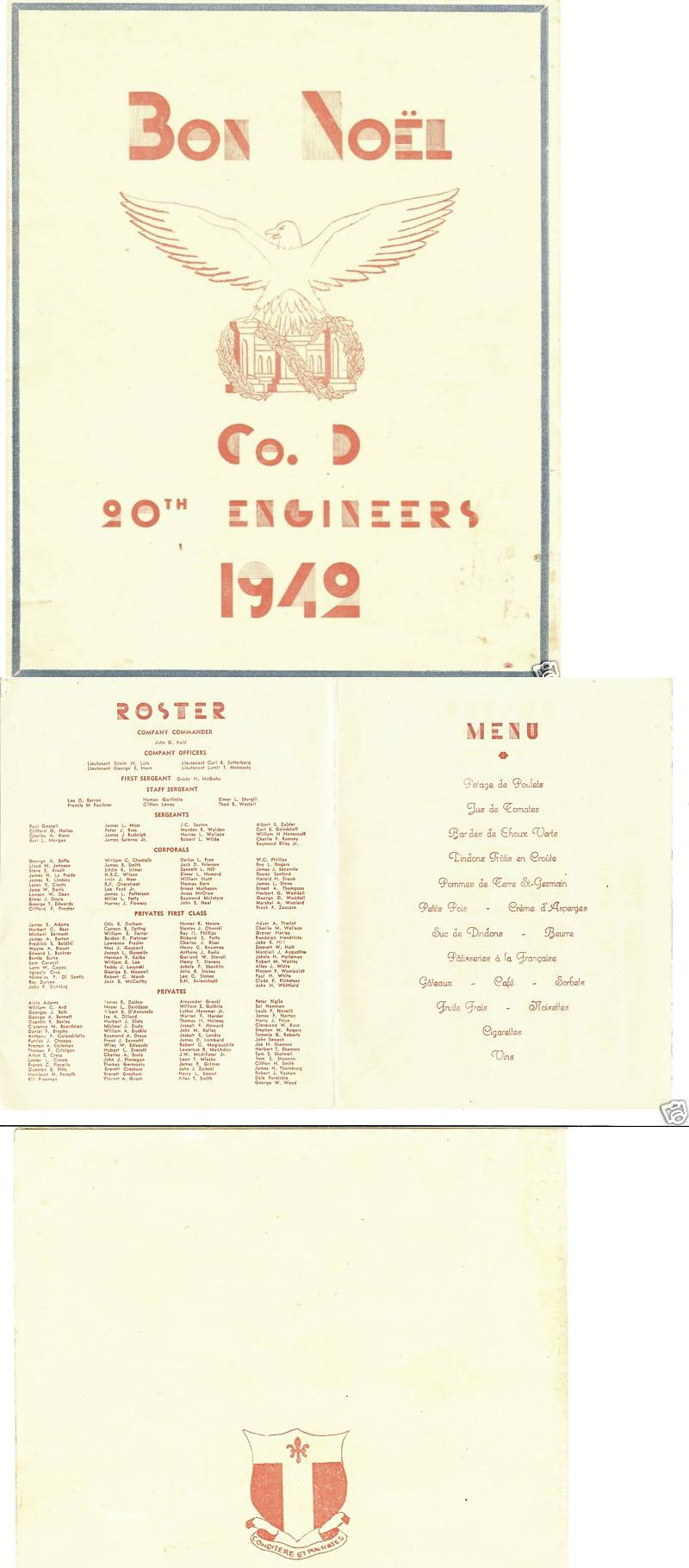
Click on the image to see the full program for the Christmas Dinner Menu
for Company D, 20th Engineers. Includes listings of all company personnel.
Stationed temporarily at Piscine, then moving on to the Hippodrome outside of Casablanca, the regiment's first assignment was to assist in unloading all cargo for North African operations. In January 1943, the 20th Engineer Regiment was relieved of cargo handling duties by a regular Port Battalion. The regiment was then given the mission to clear and fortify the Hotel D'Anfa for the Casablanca Conference, where President Roosevelt and Prime Minister Churchill met with the French and Russian representatives to map out Allied strategy for the invasion of Europe.

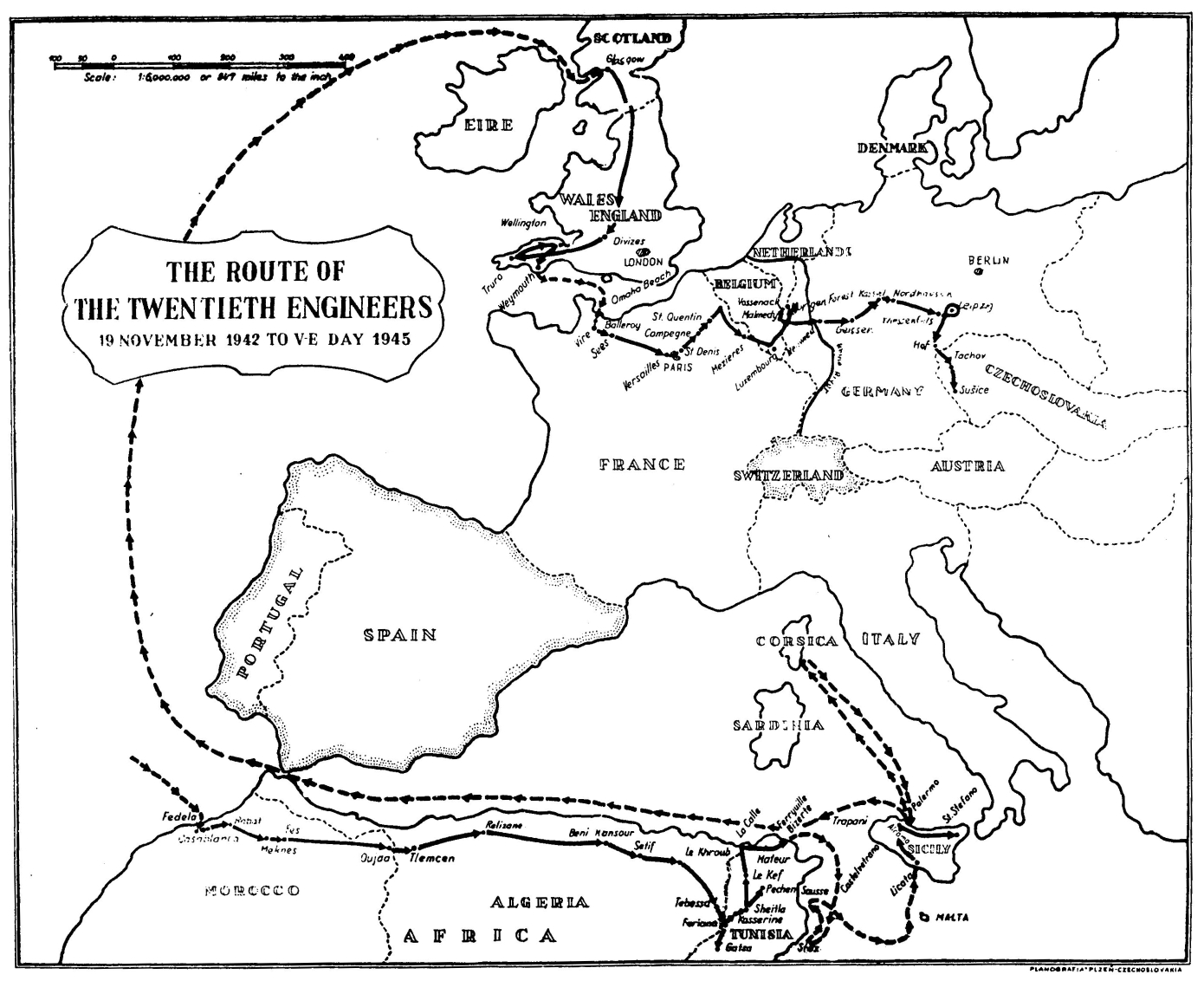
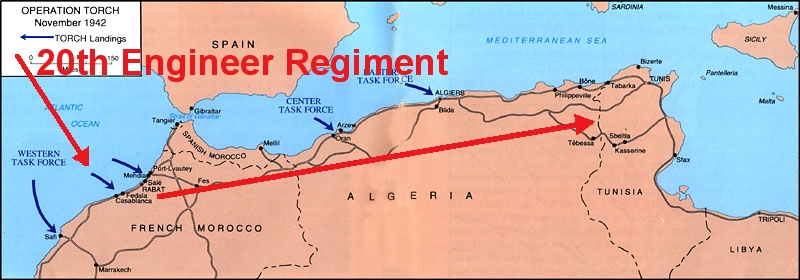 On 15 March 1943, the 20th Engineer Regiment embarked on the longest motor march in its history. The line of march went across the northern edge of French North Africa (Morocco and Algeria), over the
Atlas Mountains, for more than 1,100 miles. A trail of foxholes marked
the passage through Meknes, Fez, Oujda, Tiemsen, Relizane, L'Arba, Setif and
into Tunisia, the gateway of the war. Stationed in the vicinity of Kasserine, clearing and reconstruction of roads became a top priority. On 05 April,
the regiment was ordered to move to Gafsa to repel an anticipated counterattack by the
Germans, which never came.
On 15 March 1943, the 20th Engineer Regiment embarked on the longest motor march in its history. The line of march went across the northern edge of French North Africa (Morocco and Algeria), over the
Atlas Mountains, for more than 1,100 miles. A trail of foxholes marked
the passage through Meknes, Fez, Oujda, Tiemsen, Relizane, L'Arba, Setif and
into Tunisia, the gateway of the war. Stationed in the vicinity of Kasserine, clearing and reconstruction of roads became a top priority. On 05 April,
the regiment was ordered to move to Gafsa to repel an anticipated counterattack by the
Germans, which never came.
 On 15 April 1943 the 20th Engineer Regiment advanced northward through Thala, LeKef,
Souk-el Arba, Lacroix and LaCalle towards the Mediterranean. General
Bradley moved the entire II Corps from Gafsa to Northern Tunisia so
smoothly and secretly that the Germans were caught unaware. On 24 April,
Company B of the 20th Engineers was attached to the Free French Corps Franc d'Afrique and conducted the regiment's first assault. The attack went well.
On 15 April 1943 the 20th Engineer Regiment advanced northward through Thala, LeKef,
Souk-el Arba, Lacroix and LaCalle towards the Mediterranean. General
Bradley moved the entire II Corps from Gafsa to Northern Tunisia so
smoothly and secretly that the Germans were caught unaware. On 24 April,
Company B of the 20th Engineers was attached to the Free French Corps Franc d'Afrique and conducted the regiment's first assault. The attack went well.
The top priority of the
20th Engineers was then to clear the region's lines of communications, especially of mines and other obstacles. The Germans were in full retreat,
demolishing all bridges on their route of march. The 1st Battalion, 20th
followed closely on their heels, cutting bypasses around the blown spans. On 8 May 1943, Colonel Caffey personally led a mission into Bizerte to clear the town of Germans, and the 20th Engineers hoised the first American flag over Bizerte. The war in Africa was
soon over. During it's first campaigns in North Africa, these soldiers of the 20th Engineer Regiment won some of the Army's highest awards:
Sergeant Billie N. Grice, Alabama
Silver Star
Colonel Eugene M. Caffey, Georgia
Major James F. White, Ohio
Technical Specialist 5 Joseph F. Dardeen, Ohio
Technical Specialist 5 Herman Gillis, Georgia
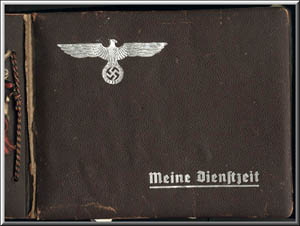
Click the photo album above to read a letter to his parents from Elmer Lee Sturgill, Company D, 2nd Battalion, 20th Engineers, about his experiences fighting across North Africa. Courtesy his son, Kenneth L Sturgill.
It was in the North African campaign that the Regimental Commander, Colonel Caffey, frustrated by the huge numbers of diverse units and confusing task organizations, directed the use of the Wavy Arrow to mark the 20th Engineer Regiment's vehicles and equipment. The red wavy arrow has been used ever since to mark 20th Engineer equipment, to include during combat operations in Vietnam and Iraq, and at present-day Fort Hood.
Shortly thereafter, Colonel Caffey was promoted to command the 1st Engineer Special Brigade, which would achieve notoriety later in the war as the Army's premier amphibious assault organization during operations in Sicily and Normandy. Colonel Caffey passed command of the 20th Engineer Regiment to Colonel Richard R. Arnold (USMA 1932), previously on General Eisenhower's personal staff. After the war, Caffey would eventually serve as the Judge Advocate General of the Army, 1954-1956.
Although the fighting was over, the bloody days for the 20th Engineers were just beginning. They moved into the Sedjenae Valley and began removal of the great minefields. Almost every day had its accident, with a cost of 7 officers and 19 men dead and many more wounded, as the engineers removed over 200,000 German mines. One of those killed in the minefields, on 6 June 1943, was Colonel Richard Arnold, the regimental commander. Lieutenant George Lux accompanied Colonoel Arnold into the minefields that day, and tripped a wire which set off a booby trap. The explosion killed Arnold on the spot; Lux suffered compound fractures of both legs, but survived the war. Colonel Arnold's fiancee was the secretary/driver for General Eisenhower; there has been speculation that, after the death of Arnold, she sought solace in the company of General Eisenhower.

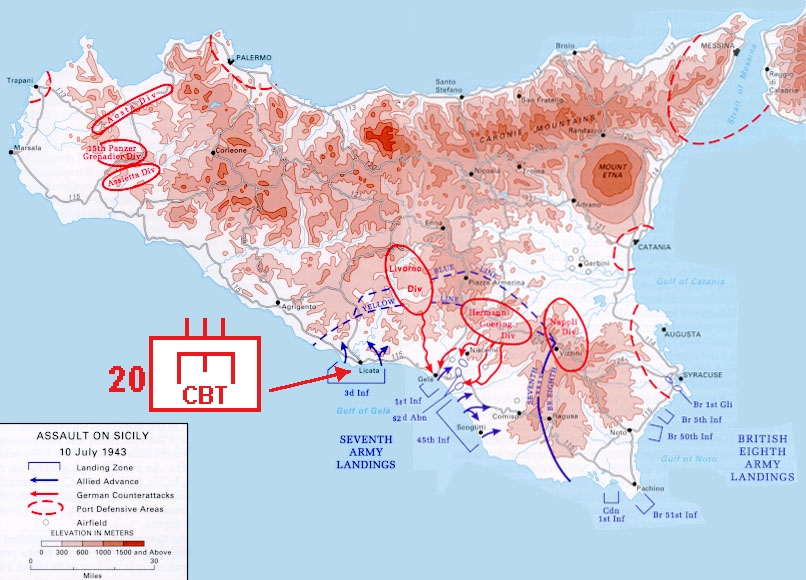
 In early July, the 20th Engineers boarded LCTs at Bizerte Harbor and once at sea, were
informed that their destination was Sicily as part of the General George Patton's new Seventh Army. According to a communique directly to the President from Maj Gen William Robert Jones, the embarked 20th Engineer Regiment received major casualties from enemy coast artillery from the region of Marsala, Sicily. On 10 July, operating while attached to the 3rd Infantry Division for Operation Husky, the 1st Battalion, 20th Engineer Regiment landed at Yellow
Beach, 2 1/2 miles east of Licata.
In early July, the 20th Engineers boarded LCTs at Bizerte Harbor and once at sea, were
informed that their destination was Sicily as part of the General George Patton's new Seventh Army. According to a communique directly to the President from Maj Gen William Robert Jones, the embarked 20th Engineer Regiment received major casualties from enemy coast artillery from the region of Marsala, Sicily. On 10 July, operating while attached to the 3rd Infantry Division for Operation Husky, the 1st Battalion, 20th Engineer Regiment landed at Yellow
Beach, 2 1/2 miles east of Licata.
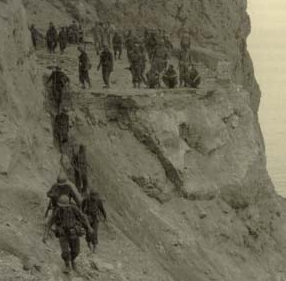 Soldiers of the 3rd Infantry Division, supported closely by the 20th Engineer Regiment, negotiate difficult terrain on Sicily's southwestern coast. National Archives.
On 12 July, the 1st Battalion moved by truck to the extreme eastern flank of the 3rd Infantry Division and took up defensive positions, then continued the attack with the division a few days later. On 17 July, the 2nd Battalion was attached to the 82nd Airborne Division for the attack into Palermo.
On 23 July, General Alexander, realizing that the Eighth Army was not strong enough to take Messina, and with the Seventh Army already in position, ordered Patton to attack east on Montgomery's left. Assigned Highways 113 and 120, Patton had room for just II Corps. One battalion of the 20th Engineers supported the 3rd Infantry Division, the other battalion supported the 2nd Armored Division. The coast road, Highway 113, ran along a narrow belt between the ridge noses and the beach, and was assigned to the 20th Engineers for improvement as an additional duty. They used captured rollers, portable rockcrushers, and stockpiles of crushed stone and asphalt to maintain the roads, build culverts, and repair railway bridges, resulting in the improvement of 18 bypasses between Palermo and Cape Orlando.
On 24 July, elements of the 20th Engineer Combat Regiment moved into Palermo to open the port. A great amount of work had to be done in cleaning up the harbor area and the piers, opening road exits, and bridging over wrecked vessels so as to secure more berthing space. The 20th Engineer Combat Regiment was assigned the dury to provide berths for thirty-six LSTs and fourteen Liberty ships. On 28 July the first of these ships ships--six coasters (two of which unloaded at Termini Imerese) from North Africa--entered the harbor. By this time, the engineers could operate the port at only some 30 percent of its full capacity because of the still uncleared wreckage of forty-four enemy vessels that had been sunk alongside of moles and in the channel. Palermo's operating capacity was raised to 60 percent by 29 August. During the period from 28 July to 31 August, the port received forty-eight ships, excluding craft. During this same period, 120,706 dead-weight tons of supplies were discharged at the port.
The 20th Engineers began repairing
the rail line between Palermo and Santo Stefano on 30 July.
They rebuilt four bridges, opened a tunnel, and replaced a
considerable amount of track. The line opened on 9 August.
On 18 August,
Rommel pulled the last of his troops off of the Island and the Sicily campaign was over.
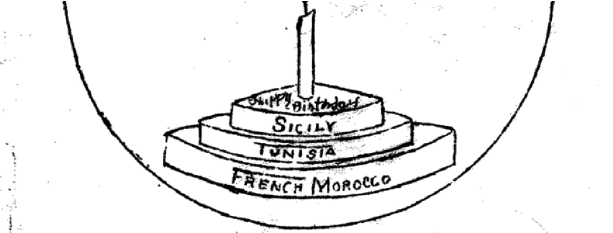
Shortly after the cessation of combat in Sicily, on 8 October 1943, the 1st Platoon, Company A, 20th Engineers
flew to Corsica to help liberate the French island occupied by the Italians and Germans.
The mission consisted mostly of removing mines left by the enemy and providing general engineer
support to the French army. The platoon lost 1 soldier killed and 5 wounded.
The first weeks of November were spent crating baggage and turning over
equipment in Sicily. On 08 November, now under the command of Colonel Edmund K. Dailey, the
20th Engineers boarded the USAT "Sloterdyk" (operated by the Dutch) in Palermo
harbor. The Corsican detachment rejoined A Company on 9 November aboard ship.
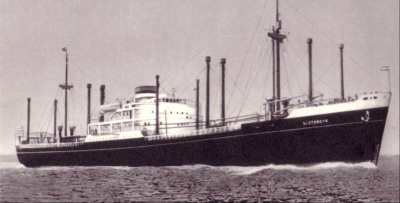
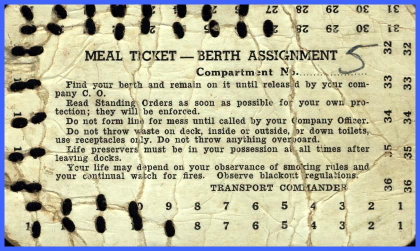
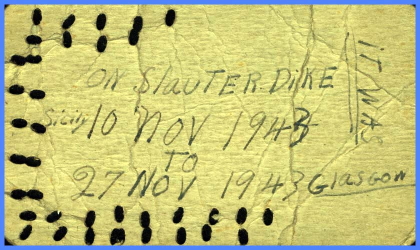
Berth assignment and meal ticket aboard the USAT Slauterdyke belonging to Elmer Lee Sturgill, Company D, 2nd Battalion, 20th Engineers, during the transit from Sicily to Scotland. Images courtesy Kenneth L Sturgill, his son.
On 15 January 1944, 20th Engineer Regiment directed to execute a major reorganization. The regiment reorganized and its elements were redesignated as follows:
- Headquarters and Headquarters Company, 20th Engineer Regiment as HHC, 1171st Engineer Combat Group
- 1st Battalion, 20th Engineer Regiment as the 20th Engineer Combat Battalion
- 2nd Battalion, 20th Engineer Regiment as the 1340th Engineer Combat Battalion (later reflagged the 54th Engineer Battalion, today part of the 173rd Airborne Brigade in Italy)
At the time of the reorganization, the regimental operations officer,
Truman H. Setliffe, was named to command the 1340th Engineer Battalion.

 On 10 February, the 20th Engineer Battalion was officially relieved from attachment to the
Southern Base Section and attached to V Corps, First United States Army.
Training intensified following a move to Wellington, England. On 01 March 1944,
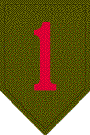
the 1st Infantry Division selected the 20th Engineers for the assault element of the
16th Infantry Regiment.
On 10 February, the 20th Engineer Battalion was officially relieved from attachment to the
Southern Base Section and attached to V Corps, First United States Army.
Training intensified following a move to Wellington, England. On 01 March 1944,
the 1st Infantry Division selected the 20th Engineers for the assault element of the
16th Infantry Regiment.
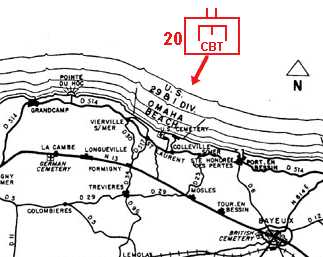
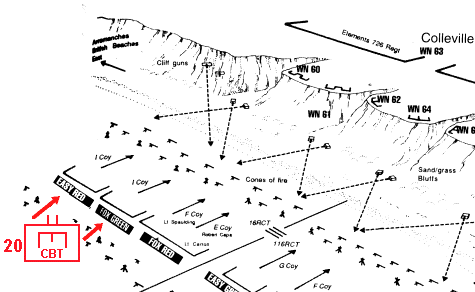
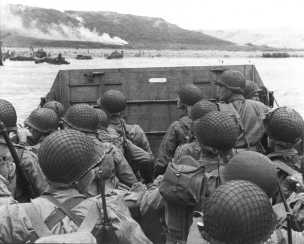 On 5 June, the 16th Infantry and 20th Engineers sailed out of Portland Harbor and into the
English Channel to join the greatest convey of assault craft the world had
ever known. Off the coast of Normandy, their craft crept slowly to the shore
toward "Easy
Red" and "Fox Green" Beaches. Struggling ashore, the men were pinned down
and found it difficult to advance in the face of brutal fire. The 16th
Infantry advanced over their own dead and were able to ascend to the cliff
areas. The 20th Engineers attacked along with them, clearing mines and removing obstacles, allowing
the supporting vehicles to move off the beach.
On 5 June, the 16th Infantry and 20th Engineers sailed out of Portland Harbor and into the
English Channel to join the greatest convey of assault craft the world had
ever known. Off the coast of Normandy, their craft crept slowly to the shore
toward "Easy
Red" and "Fox Green" Beaches. Struggling ashore, the men were pinned down
and found it difficult to advance in the face of brutal fire. The 16th
Infantry advanced over their own dead and were able to ascend to the cliff
areas. The 20th Engineers attacked along with them, clearing mines and removing obstacles, allowing
the supporting vehicles to move off the beach.
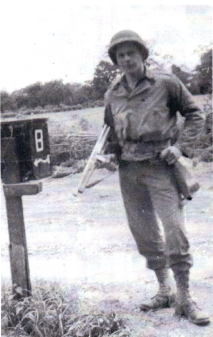
Photo shows George Griffenhagen on Omaha Beach several days after the assault.
Note the directional sign with the Wavy Arrow, the unique emblem of the 20th Engineers since
combat in North Africa
(and into the modern era,)
used to help direct assault landings on the beaches.
See a
long interview with George
Griffenhagen that was filmed by the National WWII Museum.
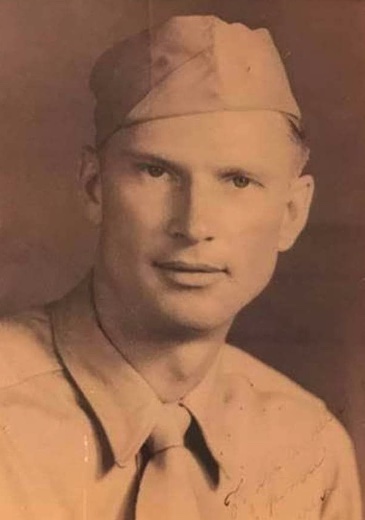
Tom Tuminello was assigned to Headquarters Company, 20th Engineer Battalion for the assault
on Omaha Beach and the continued assault across Europe into Czechoslovakia.
Tom recorded his memories of various battles, to include D-Day, the liberation of Paris,
the Hurtgen Forest, the Siegfried Line, and Susice in Czechoslovakia.
Click Tuminello's image below to go to a page to listen
to his memoirs.
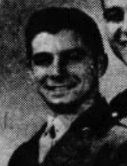
Warren Causey was assigned to Company A of the 20th Engineer Battalion for the D-Day campaign.
His son documented
Warren's memoirs from the assault landing.


|
|
GENERAL ORDERS) WAR DEPARTMENT The 20th Engineer Combat Battalion is cited for outstanding performance of duty in action. The 20th Engineer Combat Battalion was attached to the 16th Infantry with the mission of clearing the beach obstacles within the tidal range of the beach from vicinity of Vierville-sur-Mer to Colleville-sur-Mer under savage artillery, mortar, rifle, grenade, machine gun, and small-arms fire. Despite persistent enemy activity the 20th Engineer Combat Battalion, with courageous determination and tenacity of purpose, cleared gaps in barbed wire and minefields to gain the beach. The operation was especially complicated because infantry and other troops were within the danger radius cleared a beach exit through antitank ditches, road blocks, and minefields subjected to hazards of enemy fire and sniper activity, and despite heavy casualties and loss of vital equipment, the battalion, by splendid foresite and technical skill, gallantly accomplished its difficult mission of clearing the beach, removing obstacles, and assisting the infantry in a manner consistent with the highest traditions of the military service. The courageous prosecution of these extremely perilous tasks in the face of overwhelming odds and deadly enemy opposition is deserving of the highest praise. |
|
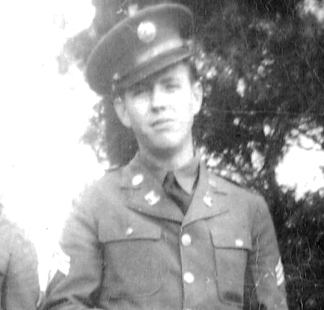
Click the photo above to see the memoirs of Sergeant John White, 20th Engineer Battalion, from the landings on D-Day.
Note the unusual wear of the crest of the 20th Engineers on the Sergeant's lapels.
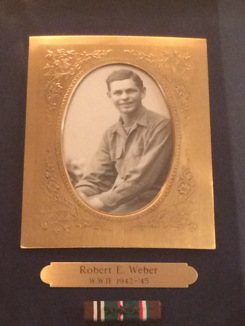
Click the photo above to see family memories and photos of Private 1st Class Robert E Weber, Company A, 20th Engineer Battalion,
from the landings on D-Day, through the battles of the Hurtgen Forest, to preparations for the invasion of Japan.
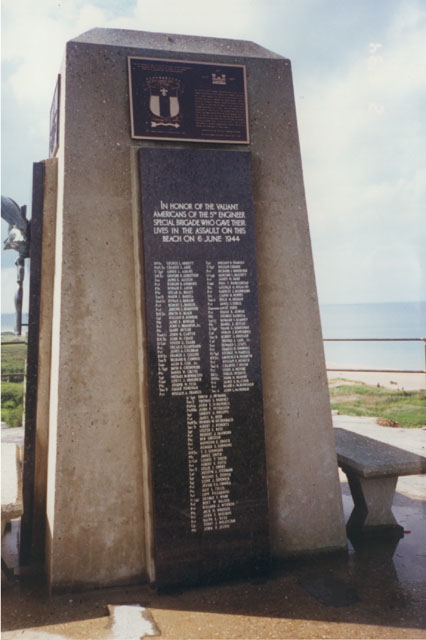
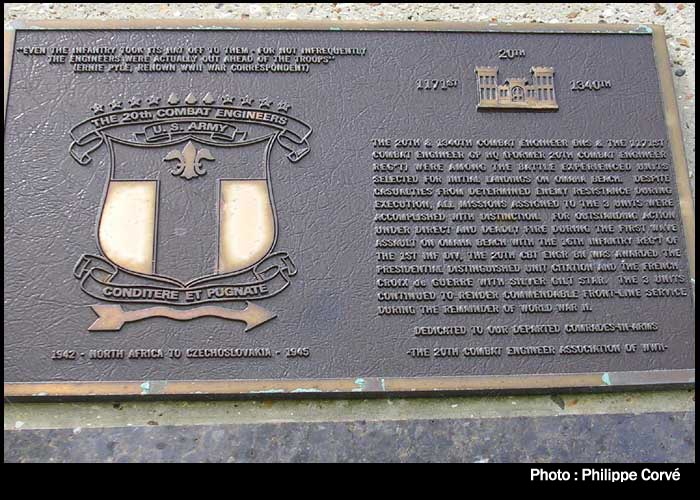
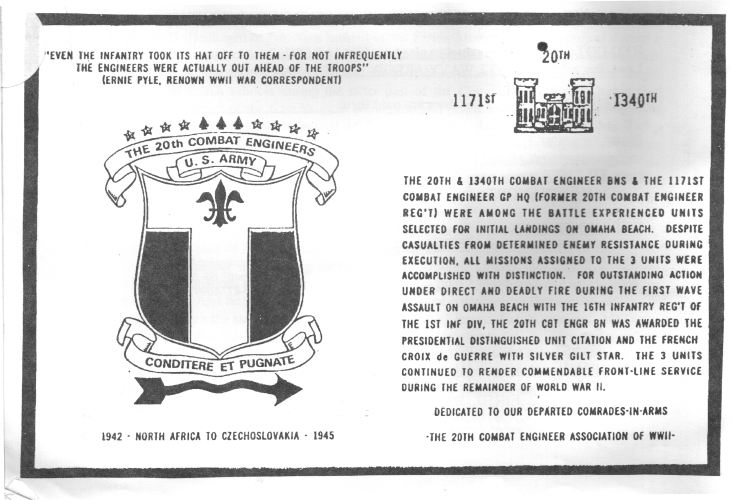
The plaque dedicated to the 20th Engineers at Omaha Beach,
mounted on the same monument as that of the 5th Engineer Special Brigade.
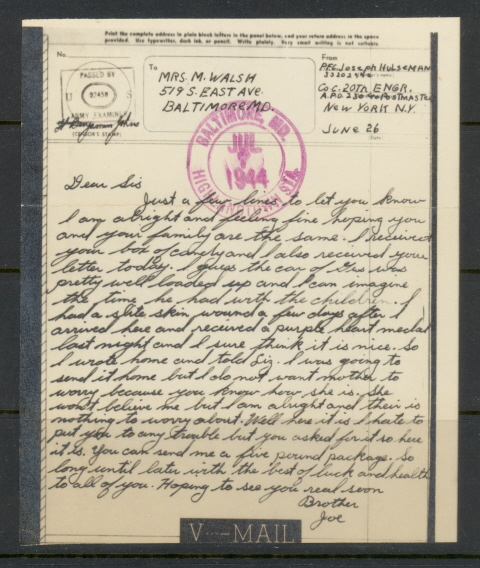
VMAIL from PFC Hulseman (Company C) to his sister, after being wounded following D-Day landings.
With most of the local resistance eliminated, the 20th Engineers joined in the pursuit
to the east and moved through the newly liberated towns lined with cheering
crowds.
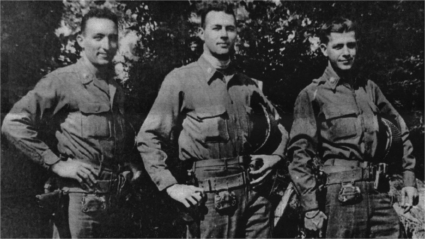
This photograph of the leadership of the 1340th Engineer Battalion (formerly 2nd Battalion, 20th Engineers) was taken on August 13, 1944, near Campeaux, France, after the breakthrough at St. Lo, and during efforts to trap the Germans in the Falaise Gap. Pictured are (left to right) Major Bruce Renfroe, Operations Officer; Lt. Col. Truman H. Setliffe, Commanding Officer; and Major John G. Auld, Executive Officer.
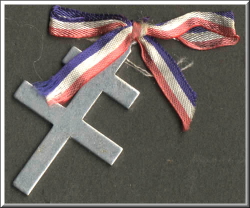
Americans liberating French towns were often presented small momentoes of appreciation.
This ribbon and Cross of Lorraine, the symbol of the French Resistance, was presented
to Elmer Lee Sturgill, 1340th Engineers.
Image courtesy Kenneth L Sturgill, his son.
For the final drive on Paris, the 20th Engineers were attached to the French 2nd Armored Division. On 26 August, engineer reconnaissance parties entered Paris and took part in the liberation of the capital--the first American units in Paris. The 20th Engineers then had the mission to construct the reviewing stand for the American march down the Champs Elysee. With the fall of Paris, the Germans were in full flight.

 The 20th Engineers were next assigned to the 28th
Infantry Division who were pushing northeast out of Paris. Clearing road rubble from
the continuous demolition of the retreating Germans became a significant task,
in addition to the never-ending mine clearing operations. On 11 September, the 20th Engineers entered
Luxembourg. All of Northern France had been cleared of Germans.
Outstripping their supply lines, the 28th Infantry Division and 20th Engineers had to hold fast and wait
for gas and ammunition to catch with them.
The 20th Engineers were next assigned to the 28th
Infantry Division who were pushing northeast out of Paris. Clearing road rubble from
the continuous demolition of the retreating Germans became a significant task,
in addition to the never-ending mine clearing operations. On 11 September, the 20th Engineers entered
Luxembourg. All of Northern France had been cleared of Germans.
Outstripping their supply lines, the 28th Infantry Division and 20th Engineers had to hold fast and wait
for gas and ammunition to catch with them.

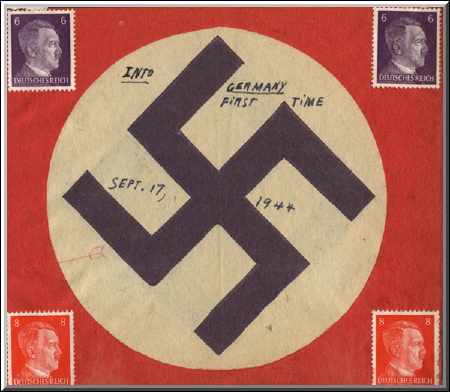
Nazi banner liberated by Elmer Lee Sturgill, 1340th Engineers, and used to commemorate
the day he crossed into Germany. Image courtesy Kenneth L Sturgill, his son.

In the middle of December, the Luftwaffe made appearances in greater numbers. The Germans, in the Battle of the Bulge, struck with overwhelming armored force in the thinly held areas of Bullingen, St. Vith and Clervaux, then broke through the lines and moved west toward Liege. On 20 December, the 20th was pulled out of the Hurtgen Forest and relocated to La Reid, Belgium, west of Spa. The next day, again attached to the 1st Infantry Division, the 20th Engineers moved to Robertville and set up a secondary defensive barrier of minefields and trees prepared for demolition. The Germans attacked strongly, but the line held. The great German drive, with the ultimate objective of reaching Antwerp and the sea and cutting off 38 Allied divisions, finally lost momentum as their own supply lines stretched.
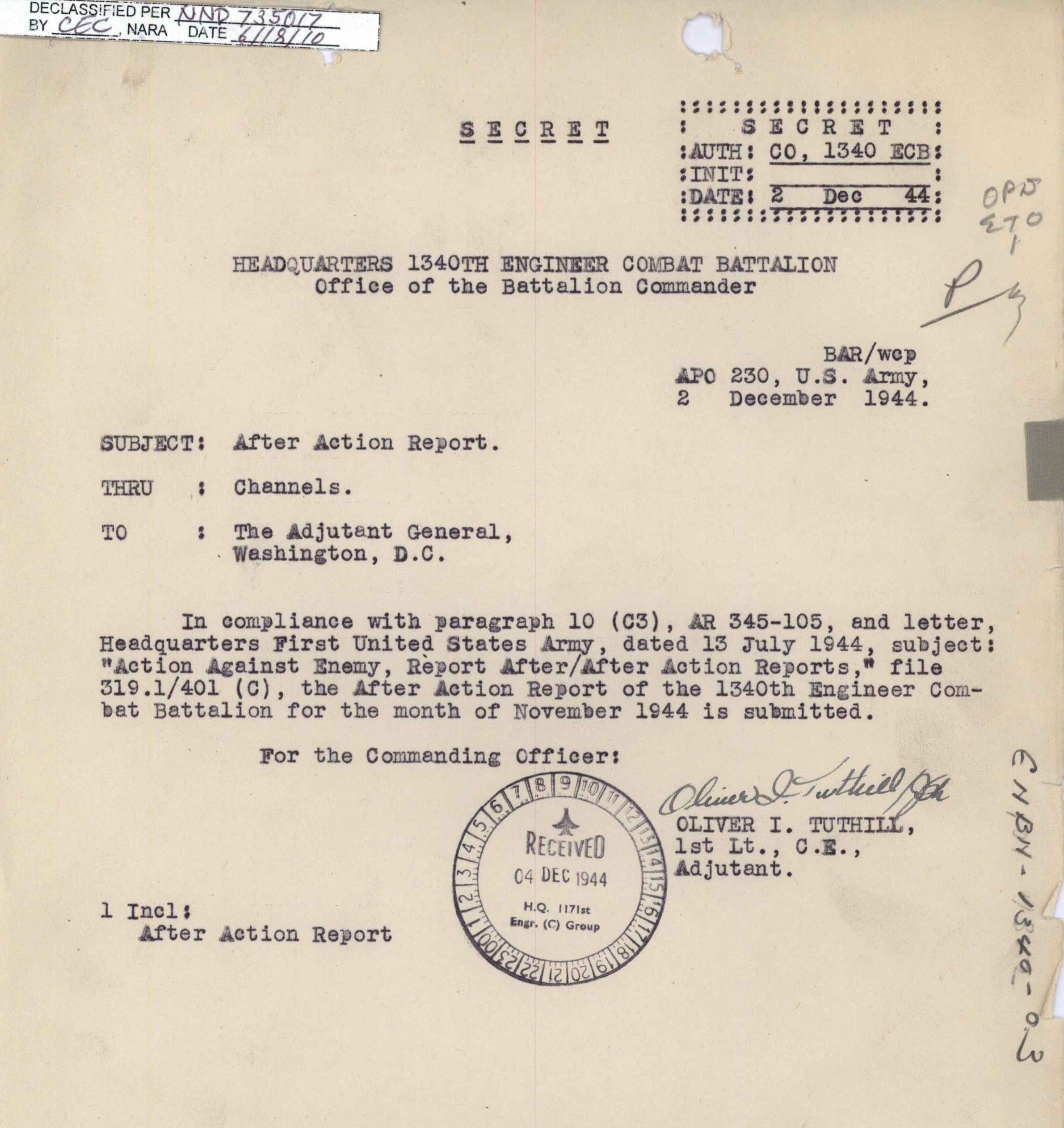
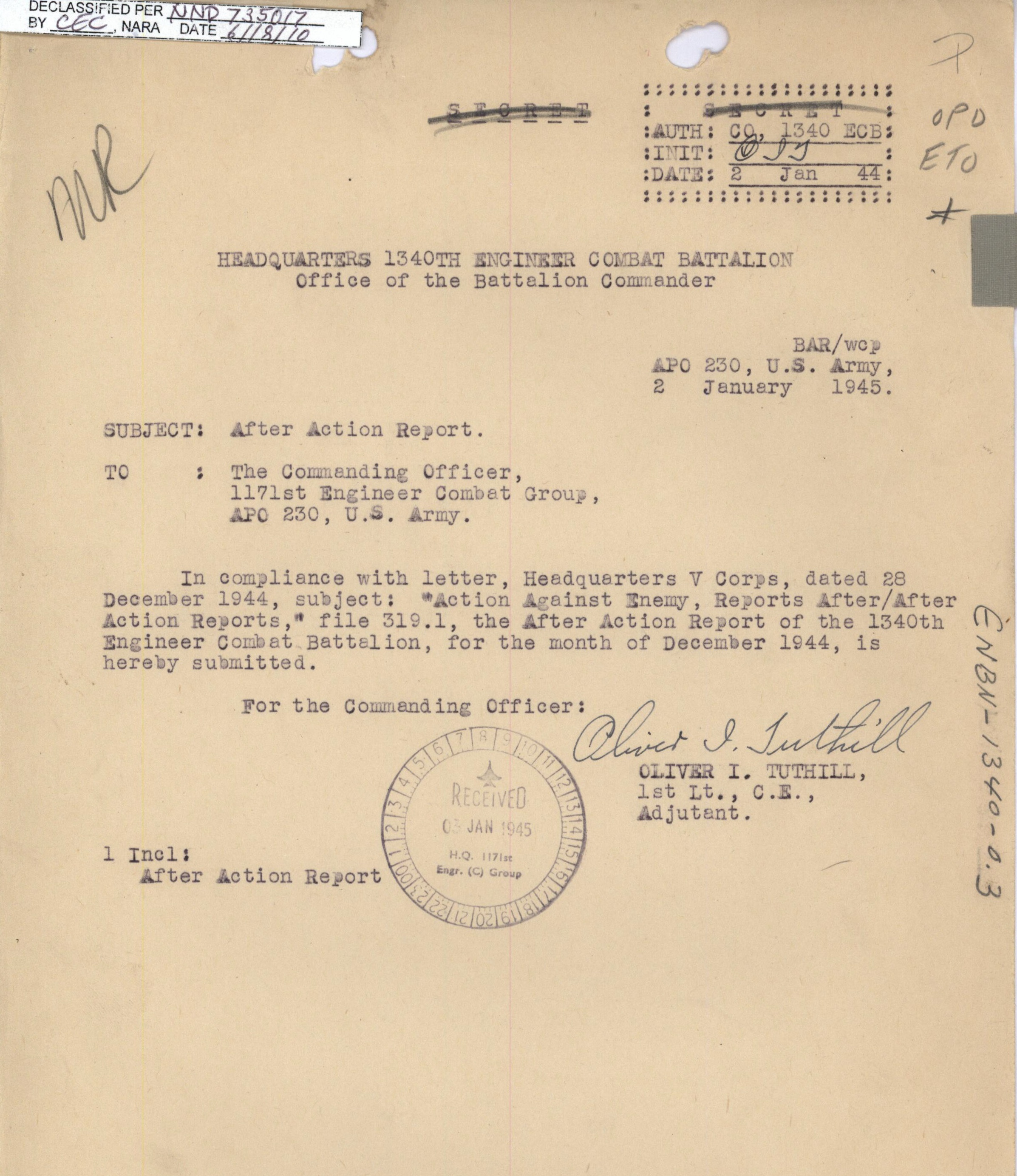
After Action Reports from the 1340th Engineer Battalion from the Hurtgen Forest.
Details of combat operations, photos, and lists of extensive killed in action and wounded.
In February 1945, the thaws came, the snow vanished and under heavy traffic the bottom dropped out of all the roads behind the front. Significant infantry support was given to the engineer missions to keep the routes open. Following the "battle of the mud" in the Ardennes, the 20th Engineers crossed the Siegfried Line again, removed mines and built a bridge at Kall. Once across the Rhine River, the 20th Engineers moved far and fast supporting the 272nd Infantry in taking Ehrenbreitstein, the fortress where the last American flag was lowered after the occupation following World War I.
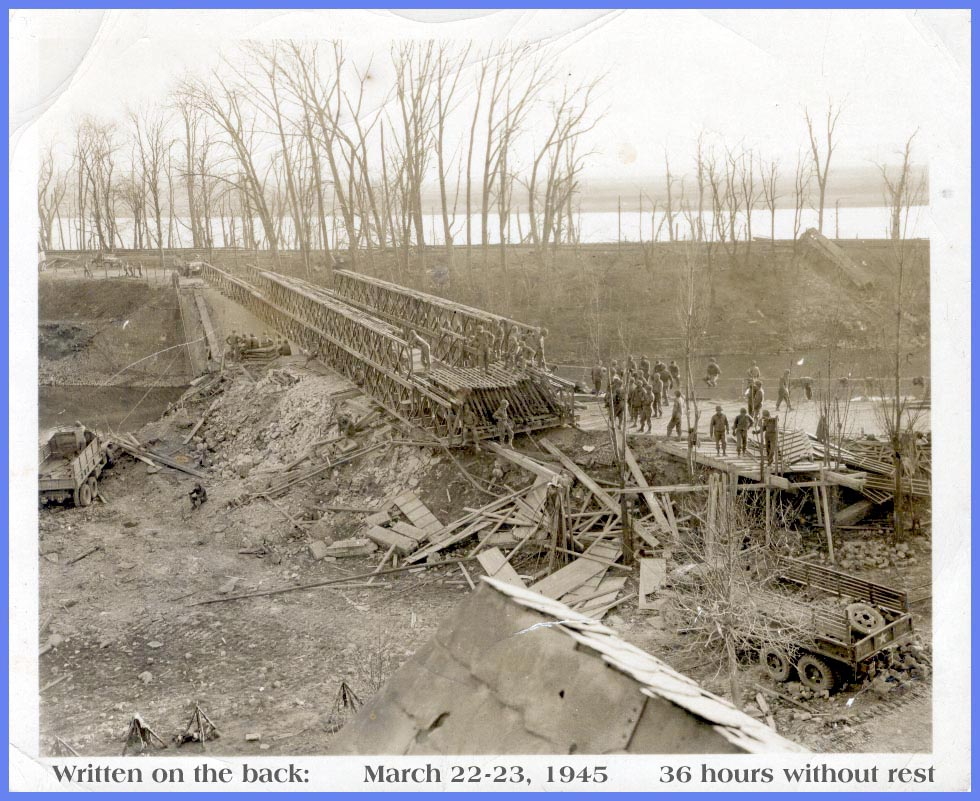
The 1340th Engineers building a Bailey Bridge. Photo from Staff Sergeant Elmer Lee Sturgill. Image courtesy Kenneth L Sturgill, his son.

Paced by the 9th Armored Division, with the 2nd Armored Division and 69th Infantry Divsion following, the 20th Engineers dashed to the outskirts of Leipzig where the Germans made a determined stand. In a short and bitter fight, the 20th Engineers lost a reconnaissance party by ambush and many engineers were captured. Following the battle, the battalion took up positions in Stossen and Wiessenfels; nearby, their brothers in the former 2nd Battalion, 20th Engineer Regiment--now the 1340th Engineer Battalion--constructed the bridge for the historic link-up with the Russians at Torgau, near Gilenburg.
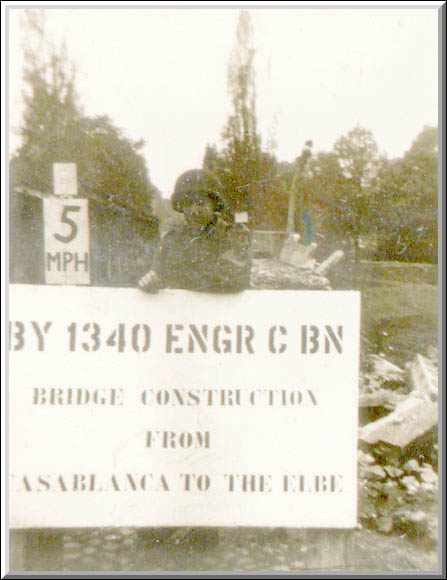
Staff Sergeant Elmer Lee Sturgill, 1340th Engineers, poses at the bridge across the Elbe River. Image courtesy Kenneth L Sturgill, his son.
On 01 May, the 20th Engineers moved to Munchberg then into Czechoslovakia, building a 130 foot double-double Bailey bridge for the 1st Infantry Division to cross at Cheb.
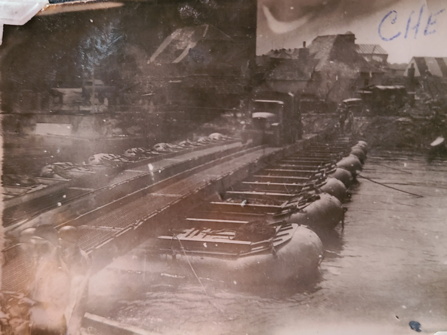
The pontoon bridge at Cheb. Photo taken by Corporal James Di Guglielmo, Company B, 20th Engineers.
On 07 May, all resistance in Czechoslovakia stopped and V-E Day had arrived. The 20th Engineers had earned a little rest from their hard labor and they had time to remember old-timers who were no longer with them, and think of the future that lay ahead for the battalion.
And the future looked even tougher as the 20th Engineers were told to prepare to move to the Pacific Theater to support the war against Japan. In an excerpt from a letter from Captain Walter C. MacHaley to Sergeant John White: "In four days I lose all men with eighty five or more points to the 146th Engineers. Looks like the only old timers that will be left are myself and the other officers. The 20th is now a Class II outfit and soon as it's refilled with replacements it will be off to the Pacific."
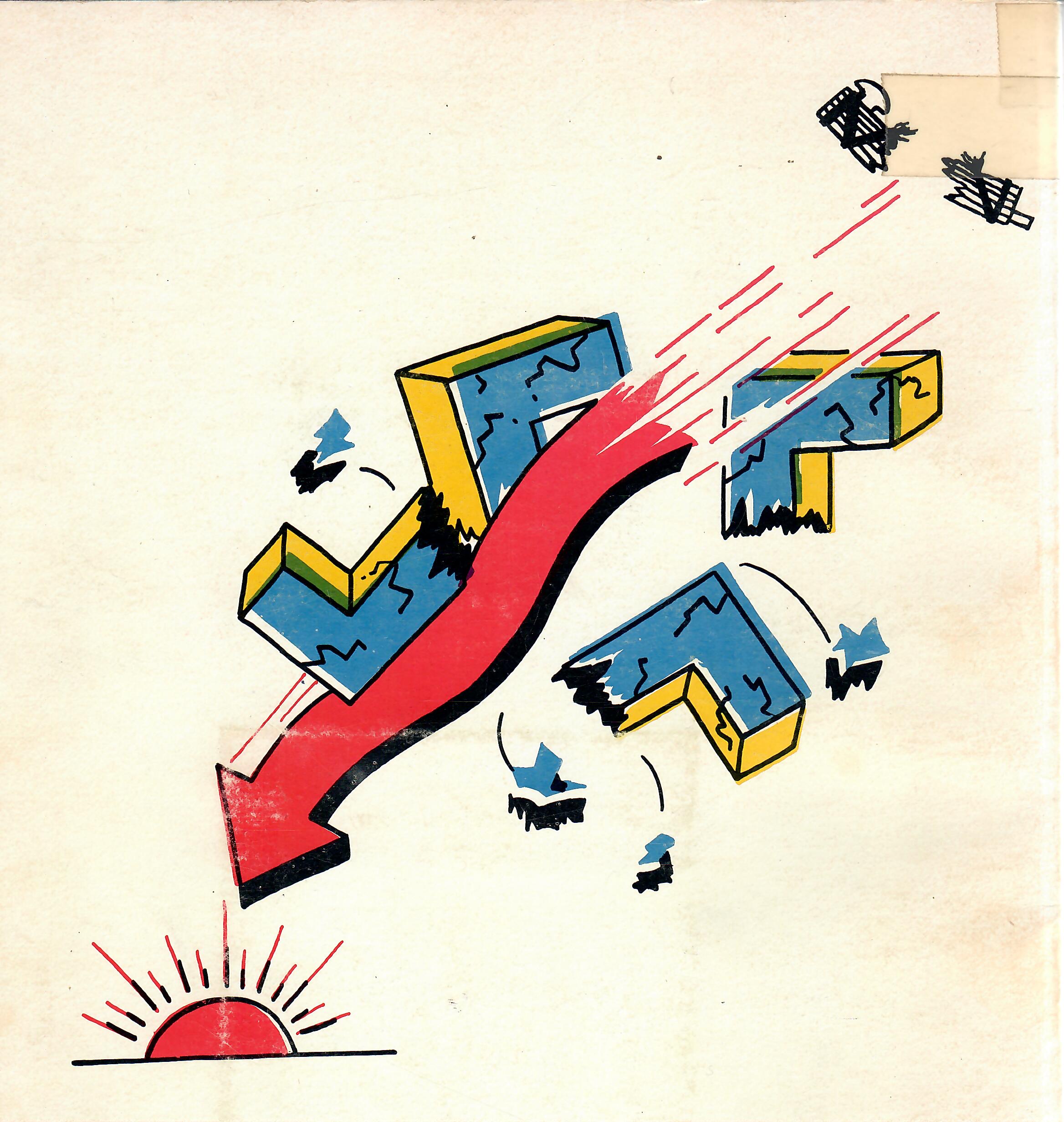
From the unit history printed while still in Czechoslovakia as it reorganized to move to Japan,
the back cover illustrated the path of the Wavy Arrow's 20th Engineers from
first beating the Fascists of Italy, and then the Nazis of Germany,
and moving next to victory against the Rising Sun of Japan.
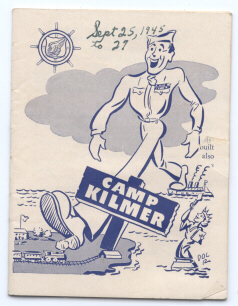 But of course because of the atomic bomb, the planned invasion of Japan was never executed. The 1340th Engineer Battalion returned to the United States in January 1946, and was inactivated at Camp Kilmer, New Jersey. On 30 March 1946, the 20th Engineer Combat Battalion was inactivated in
Frankfurt, Germany. The former regimental headquarters, the 1171st Engineer Group, was transferred to Frankfurt, Germany, for infrastructure repairs and construction; the commander of the 1340th Engineers, Truman H. Setliffe, was named the new Group commander. The 1171st
remained in Germany for most of the rest of 1946, then was inactivated.
But of course because of the atomic bomb, the planned invasion of Japan was never executed. The 1340th Engineer Battalion returned to the United States in January 1946, and was inactivated at Camp Kilmer, New Jersey. On 30 March 1946, the 20th Engineer Combat Battalion was inactivated in
Frankfurt, Germany. The former regimental headquarters, the 1171st Engineer Group, was transferred to Frankfurt, Germany, for infrastructure repairs and construction; the commander of the 1340th Engineers, Truman H. Setliffe, was named the new Group commander. The 1171st
remained in Germany for most of the rest of 1946, then was inactivated.
After the war, families could choose to have their loved ones returned to the United States, or have them buried in special cemeteries established by the American Battle Monuments Commission.
To honor these heroes, European families have a program to adopt the graves. An
example is Bernadette Penders-Ernes, who adopted the grave of Technician 5th Grade
Rodney S. Perry. Perry was killed on 26 April 1945 at the battle of the Hurtgen Forest
and is buried in the Netherlands American Cemetery near Margraten, the Netherlands.
Bernadette's parents were born in 1931 and 1933 and suffered through the war; they would
also visit the cemetery to honor the Americans buried there. These photos show Bernadette and the
flowers she placed on Perry's grave in May 2025.


See the full list of soldiers who are buried overseas from the 20th Engineer Regiment, 20th Engineer Battalion, 1340th Engineer Battalion (formerly 2nd Battalion, 20th Engineer Regiment), and 1171st Engineer Group (formerly Headquarters, 20th Engineer Regiment).
British
IX Corps
French
Corps d'Afrique
2nd Armored Division
U.S.
First Army
Third Army
Seventh Army
II Corps
V Corps
82nd Airborne Division
1st Armored Division
2nd Armored Division
5th Armored Division
9th Armored Division
16th Armored Division
1st Infantry Division
2nd Infantry Division
3rd Infantry Division
5th Infantry Division
8th Infantry Division
9th Infantry Division
28th Infantry Division
34th Infantry Division
35th Infantry Division
45th Infantry Division
69th Infantry Division
99th Infantry Division
106th Infantry Division
Information provided by George Griffenhagen in the December 2005 edition of "The Wavy Arrow" newsletter of the 20th Combat Engineer Association of World War II
Click on any of the names below for stories or biographies about soldiers of the 20th Engineers in World War II.