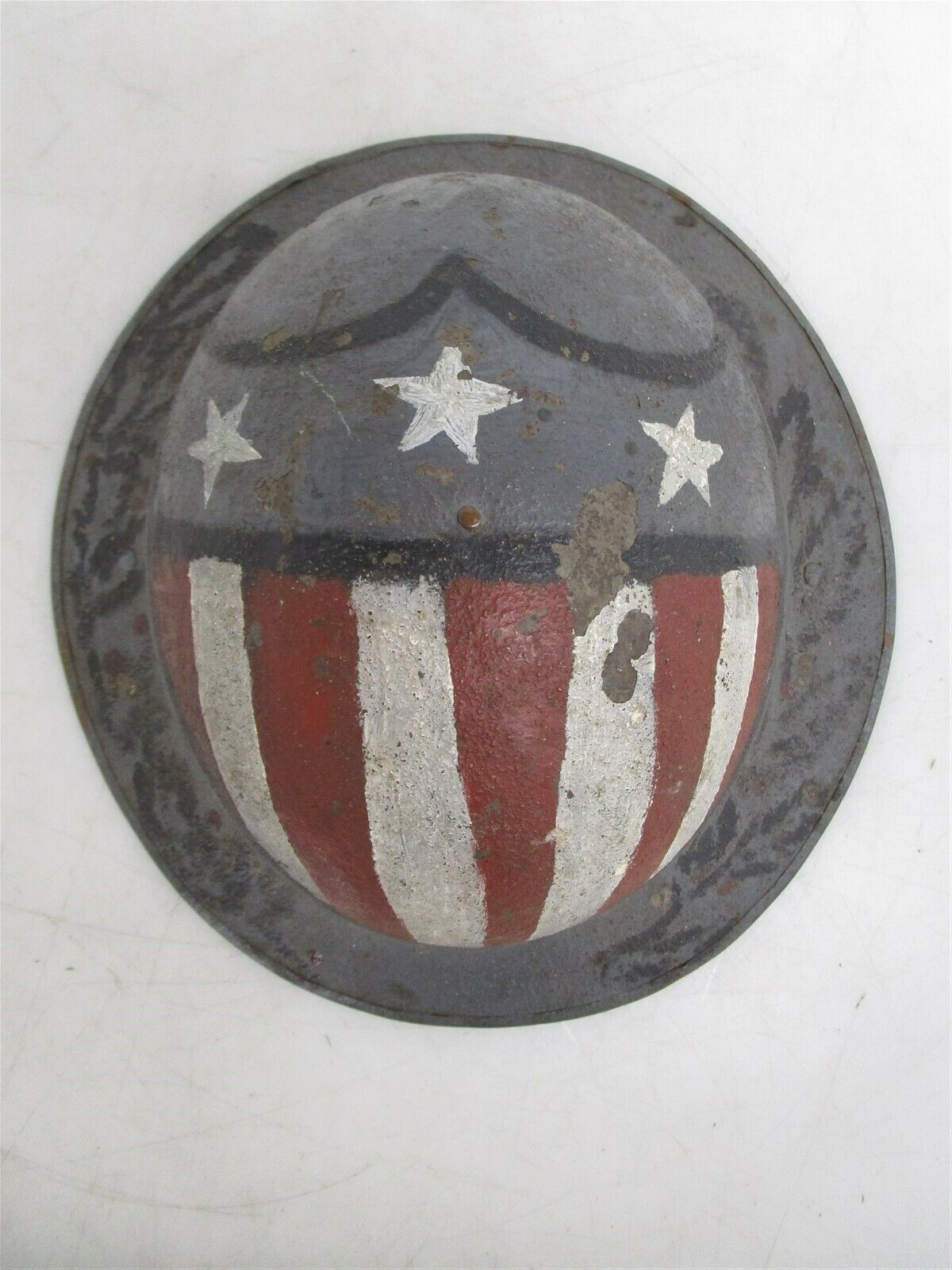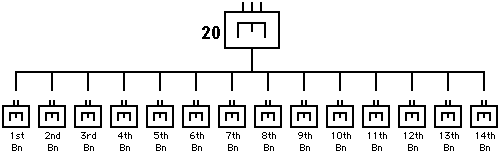
Second Battalion, 10th Engineers -- 12th Battalion, 20th Engineers

Note: Most of the text of this article comes from "TWENTIETH ENGINEERS -- FRANCE -- 1917-1918-1919"
The Tenth Engineers (Forestry) was one of the pioneer units in the new war Army of the United States. The formation of this unique body of engineers was commenced in May, 1917 , the organization and recruiting being very largely accomplished by Forest Service, from which also came an important percentage of the personnel.
The two battalions were formed
by the 1st of August at American University, at which camp they were among the
newcomers, and from then until September 8th was spent in military drill and equipping.
Sunday, the 9th of September, the regiment marched to Roslyn where it entrained for Jersey
City, arriving there the morning of the 10th.
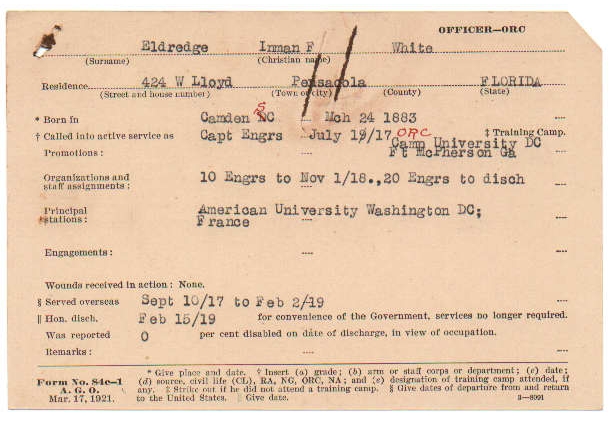
Ferried across the Hudson to the Cunard pier on the New York side of the Hudson and boarding the RMS Carpathia, the first forest troops left for France on the evening of the same day. On board were the Second Engineers only besides the foresters. The 10th Engineers were among the first 10,000 troops sent to France.
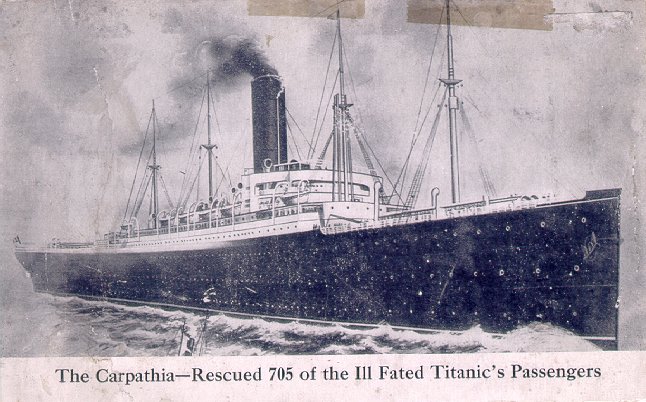
The Carpathia had quite the history of her own, in addition to transporting the 10th Engineers to France.
She was the first to arrive to help rescue survivors of the Titanic disaster.
Later in the war, on 17 July 1918, she was torpedoes by a U-Boat and sank off the coast of Ireland.
Two days more and the Carpathia reached Halifax N.S. where the formation of a convoy was in progress. On the 21st the convoy of thirteen ships, some with Australian and Canadian troops aboard, headed for England in three columns. ''Carpathia'' enjoyed a voyage unmolested by enemy subs and upon arrival at Glasgow, on the Clyde, the American troops were received by the Scotch with enthusiasm. These were the first Yanks to land in the historic city and the excitement was intense as the soldiers of the new Ally disembarked.
A few days were spent in camp at Southampton, and on the night of October 6th the regiment crossed the Channel on "La Marguerite,'' arriving in Havre at 5 o'clock in the morning. A short period was spent in a British 'rest camp' at Havre and at 10 P.M. a thirty six hour boxcar ride began which men past the palace of Versailles and set them down almost in the center of France.
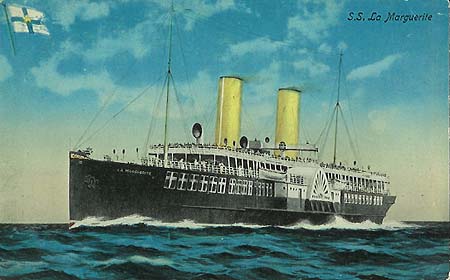
Click on the postcard of the La Marguerite for more information on this workhorse cross-Channel steamer
Two weeks were spent in the mud there while the arrival of motor and sawmill equipment from the "Carpathia'' was awaited, during which time the inevitable drill was indulged in extensively. Only a part of the regiment's equipment had arrived on the "Carpathia.''
The immediate needs of the vigorous young A. E. F. were such as to require the forest troops to be split into several parts for service in widely separated regions of France. Two battalion headquarters were established by the 1st of November, one at Pontenx-les-Forges in the Landes pines and the other in the fir region, at Levier (Doubs). The logging equipment was at that time very incomplete and some of the detachments were reduced to the expedient of hauling logs by manpower. The first mill to begin operations was a small French affair that bit into the first log sawed by American forest troops on November 25th, 1917, at Levier. Two days later the Mortumier operation, near Gien (Loiret) started the first American mill. During the month of December a large part of the work was necessarily confined to the production of round products. Two French and one American mills were under way by the first of the month and before the end of December two American and four French mills were at work. The December production, all to the credit of the Tenth Engineers, was as follows: Lumber, 321,000 F. B. M.; Piling, 205 pieces; Ties, 12,031 pieces; Poles, 20,025 pieces; Logs, 33,864 pieces; Cord wood, 4,164 steres (cubic meters); Fagots, 1,500 steres.
The early distribution of the regiment may be briefly summarized as follows, together with the first stations that each detachment held and the designations given the companies after the reorganization, of the forest troops consolidated them all under the Twentieth Engineers. The old designations will be used as a rule.
Regimental Headquarters—Tours, merged with HQ. of Twentieth.
First Bn. Hq.—Pontenx, Eleventh Bn.
Co. A. -Thirty second Co.— 1/2 Pontenx District; 1/2 Brittany.
Co. B. -Thirty - third Co.—Pontenx District.
Co. C. -Thirty - fourth Co.—Pontenx District.
Second Bn. Hq.—Levier, later Besancon, in the Doubs, Twelfth Bn.,
Co. D.-Thirty - fifth Co.—Arc-sous-Montenot (Doubs).
Co. E.- Thirty - sixth Co.—1/2 Vaney (Cote d Or); 1/2 at Gien (Loiret).
Co. F.—Thirty - seventh Co.—Levier (Doubs).

Click on the image to view a booklet published by Company E, 10th Engineers after the war
It includes narrative, photographs, and a roster of unit personnel
Company D was stationed at Arc-sous-Montenot (Doubs), six miles from Levier and F Company, from the beginning until August, 1918, when it move to Morteau. A 20-M American mill was built; a French meter gauge railway was taken over; and a logging camp made at Le Russey, 6 miles away. Here the company stayed until New Year's Day, 1919, when it left for Brest.
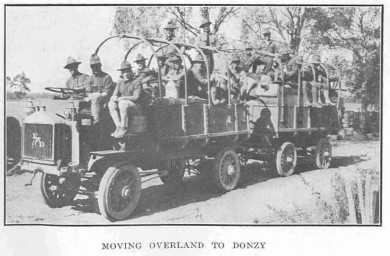
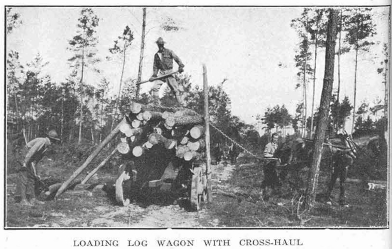
36th Company, 20th Engineers - Company E, 10th Engineers in action
Company E, Second Battalion, was split into two detachments upon leaving Nevers October 23rd, 1917. The company organization with 90 men was assigned to operate at Vanvey (Cote d'Or), 100 miles northeast of Nevers. Logging began at once, and a 10-M mill started sawing December 15th. March 15th, 1918, the outfit was reinforced by Company B, 41st Engineers. By July 1st the Vanvey tract was cleaned up and the detachment moved to St. Julian (Cote d'Or), 50 miles further south and 10 miles north of Dijon, where a 20-M mill was built to operate in hardwood. Cutting stopped November 20th and December was spent in drilling and re-equipping with modern packs, etc. At 5 A.M., January 1st, 1919, the detachment started for Brest, arriving there at noon of the 4th.
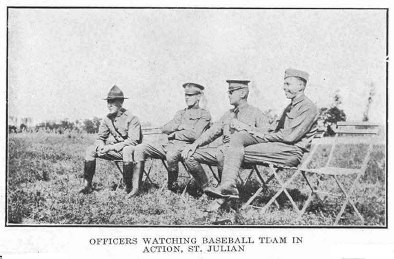
Officers of 36th Company watching a baseball game at St. Julian
The other half-company of "E," known as the First Detachment, 10th Engineers, left Nevers October 25th, 1917 and took station at Gien (Loiret). Their operation commenced at Mortumier, 5 miles away. A 10-M mill was build and sawing was started at 9 A.M., November 29th, 1917, being the first lumber cut by U.S. troops with American machinery. December 24th, 40 men of Company A, 503rd Engineers were added. During the March and April offensive the outfit was hair-triggered for service at the front, but it was not called.
During the summer the detachment had its share of forest fire fighting. August 22nd the operation at Mortumier was finished and the outfit moved to Ciez-Colloutre (Nievre) by motore truck, erecting the same mill used on their first "chance." Company C, 321st Labor Battalion (colored) was assigned to the operation for fuel wood production, and in October, 1918, Battery C, 48th Coast Artillery, was also put on fuel wood. The total strength of the operation was over 800 men. December was spent in organizing for return to the States, although the mill continued to run until January 9th, 1919, owing to failure to receive the necessary orders to quit. The detachment pulled out for Brest January 10th, where it rejoined the other half-company January 13th.
Company F went directly from Nevers to Levier (Doubs) and has the distinction of having sawed the first board cut by Americans in France, the 25th of November, on a small French mill. The region was high and cold, being near to the boundary of Switzerland. The company came home with D, E, and the norther detachment of Company A.